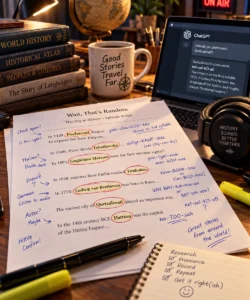
One of the unexpected challenges of producing a daily history podcast has very little to do with history itself. It’s pronunciation. Every episode introduces me to people, places, rivers, mountains, emperors, explorers, inventors, scientists, and cities from every corner of the world. Some names are easy. Others…
Well, others make me stare at the script for a few seconds and quietly ask myself, “How on earth do you say that?”
Before I record an episode, I spend a surprising amount of time researching unfamiliar pronunciations. I listen to native speakers when I can find recordings. I compare multiple pronunciation guides. I check different sources because even experts sometimes disagree. And yes…
ChatGPT has become one of my favorite tools during that process. I use it to break down difficult names into sounds I can actually understand, and it’s helped me become much more confident tackling words I never would have attempted a year ago. Most of the time, I think I get pretty close.
Sometimes… I even get them right on the first take.
But history is wonderfully international. Languages have sounds English doesn’t. Regional accents change the way names are spoken. Scholars don’t always agree. Sometimes the same historical figure is pronounced differently depending on which country you’re in.
Which means that every once in a while… I’m going to completely miss the mark. If that happens, please know it isn’t because I didn’t care. Quite the opposite. I probably spent ten minutes trying to figure out how to pronounce that one name before I ever hit the record button. The funny part is that I’m hardly the person you’d expect to be tackling words from medieval Poland, ancient Egypt, or 16th-century Japan. The full extent of my formal foreign language education is that I took three years of Spanish II in high school.
Yes…
Three years.
Of Spanish II.
I know exactly how that happened. I wasn’t exactly giving 110 percent, and somehow I skated through three years of Spanish II on pure luck. That’s a surprisingly difficult strategy to pull off when the subject is an entirely different language. Needless to say, my guidance counselor probably wasn’t imagining I’d someday be trying to pronounce Lithuanian dukes, Aztec rulers, and Icelandic volcanoes into a microphone. 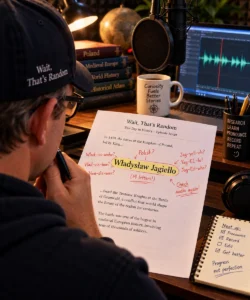
The good news is that this podcast has never been about pretending to know everything.
It’s about learning.
Every episode teaches me something new. Sometimes it’s a historical event I’d never heard of. Sometimes it’s a fascinating person who somehow slipped through the cracks of history. And sometimes it’s finally figuring out how to pronounce a 14-letter surname after the fifth attempt.
When I listen back to the earliest episodes of Wait, That’s Random, I hear plenty of things I’d do differently today.
The storytelling is better now.
The pacing feels more natural.
My delivery has become more conversational.
And yes… The pronunciations have improved too.
That’s actually one of the reasons I started this podcast in the first place. I wanted to become a better narrator. The wonderful side effect has been discovering incredible stories that I get to share every single day.
So if you ever hear me pronounce something in a way that makes you wince… Feel free to let me know. Just be gentle. There’s a pretty good chance I’ve already spent the last fifteen minutes arguing with myself—and ChatGPT—about how it was supposed to sound.
And if nothing else… At least we can all agree that history is a lot more fun when you don’t skip the hard names.